


You’ve invested in a website. You’ve spent time choosing the right images, writing about your services and making sure everything looks professional.
Perhaps you’ve even started posting on social media, tried Google Ads or paid someone to help with your SEO.
Yet the enquiries are few and far between.
Meanwhile, you look at your competitors and wonder how they’re managing to attract customers when you’re offering a perfectly good service yourself.
It’s frustrating, especially when you’ve already invested time and money into getting your business online.
The natural reaction is to assume you need more visitors. More advertising, more social media posts, better Google rankings. Something to get people onto the website.
But in my experience working with small businesses, the problem isn’t always a lack of traffic.
Sometimes people are finding the website but aren’t convinced enough to get in touch. Other times, the business is attracting the wrong audience, or the website simply makes it harder than necessary to enquire.
And occasionally, nobody actually knows what’s happening because the right tracking was never set up.
Before investing another penny in marketing, it’s worth finding out where things are going wrong.
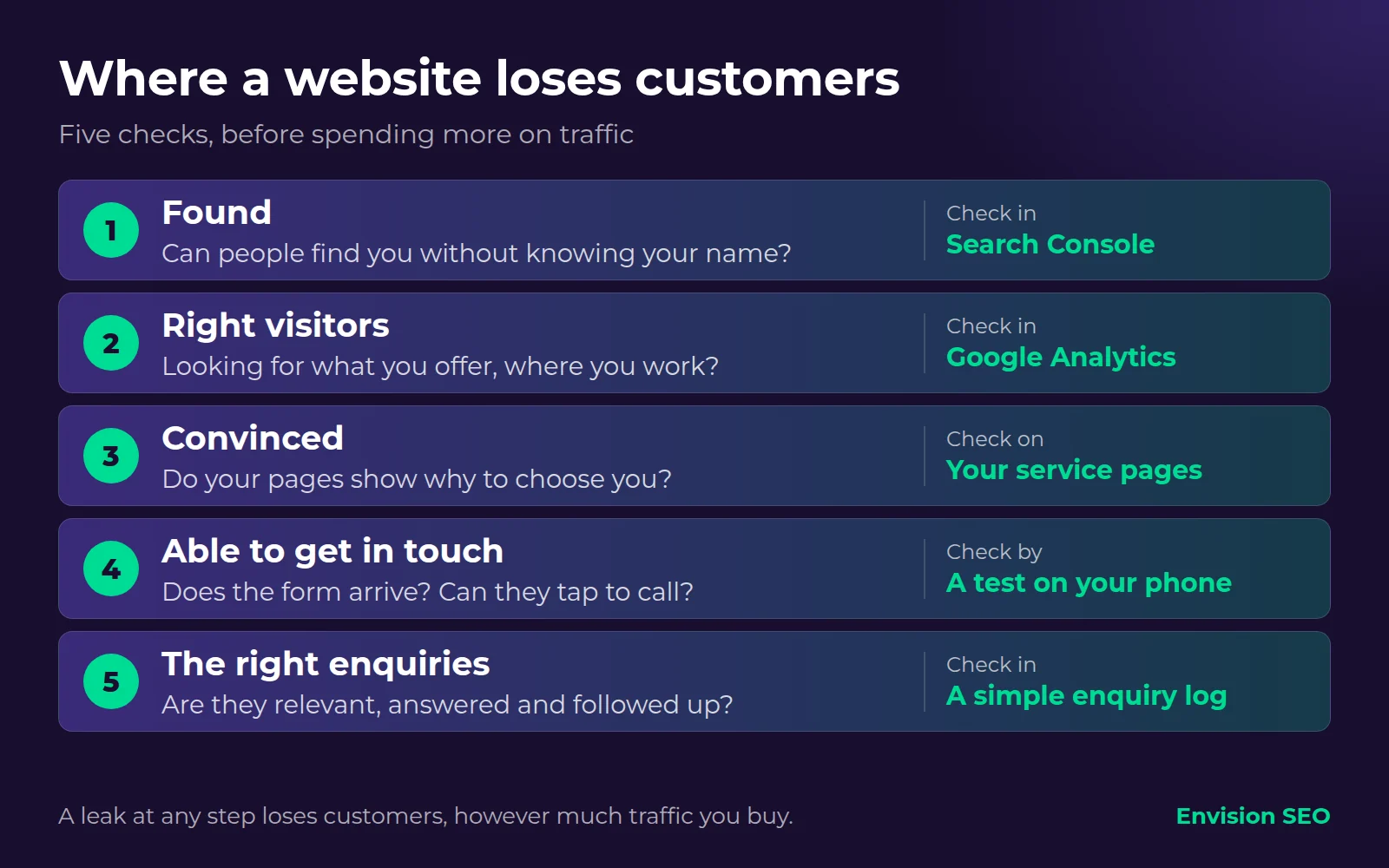
The short answer: a website usually fails to bring in customers at one of five points. People can’t find it for the services it offers, it attracts the wrong visitors, its pages don’t give people a reason to choose the business, getting in touch is harder than it should be, or the enquiries that arrive aren’t the right ones. Find out which before you spend more on traffic.
Key takeaways
- More traffic only helps if the website already turns visitors into enquiries. Otherwise you pay to bring more people to the same leak.
- Check five things in turn: whether people find you for your services, whether they’re the right visitors, whether your pages build trust, whether getting in touch is easy, and whether the enquiries are relevant.
- Test your own contact form on your phone. A form that looks fine but never reaches your inbox loses customers silently.
- Good SEO, clear service pages and genuine proof of your work help with both Google and AI assistants such as ChatGPT. There’s no separate AI shortcut.
Having a website doesn’t mean customers can find you
One of the first things I look at when reviewing a business website is whether it can be found by people who don’t already know the company exists.
There’s an important difference between someone searching for your business name and someone searching for the service you provide.
Imagine you own a kitchen design company in Sheffield.
Someone who has been recommended your business might search for your company name, find your website and get in touch. That’s brilliant, but the enquiry came from an existing recommendation.
Now imagine a homeowner searching for “bespoke kitchens Sheffield” or “kitchen installation near me“.
They’re actively looking for a service, but they might never discover your business if you aren’t appearing in the results.
The same applies to accountants, solicitors, tradespeople, consultants and almost every other service-based business.
This is where local SEO becomes particularly valuable. It’s about helping your business appear for relevant searches in the locations you serve, rather than relying entirely on people already knowing your name.
Your Google Business Profile plays an important role here, too.
According to Google’s own guidance on local rankings, local results are mainly influenced by relevance, distance and prominence. Complete business information, appropriate categories and customer reviews all contribute to how Google understands and presents a business.
A quick way to check: in Google Search Console, look at the searches that bring people to your website. If almost all of them contain your business name, people who don’t know you yet aren’t finding you.
So, if your competitors regularly appear in local searches while you don’t, it’s worth investigating why. A local SEO audit is a good place to start.
That doesn’t automatically mean they’re better at what they do. They may simply have a stronger online presence.
But what if people are already visiting your website?
This is where things become more interesting.
Let’s say your website receives 500 visits a month but only two enquiries.
Would doubling your traffic solve the problem?
Possibly. But if those visitors aren’t interested in your services, or they’re leaving because something on the website puts them off, you could end up spending more money without seeing much improvement.
Here’s the arithmetic. Two enquiries from 500 visits means 0.4% of visitors get in touch. Double the traffic to 1,000 visits and, if nothing else changes, you get four enquiries. Keep the same 500 visitors but make the pages good enough that 2% of them enquire, and you get ten.
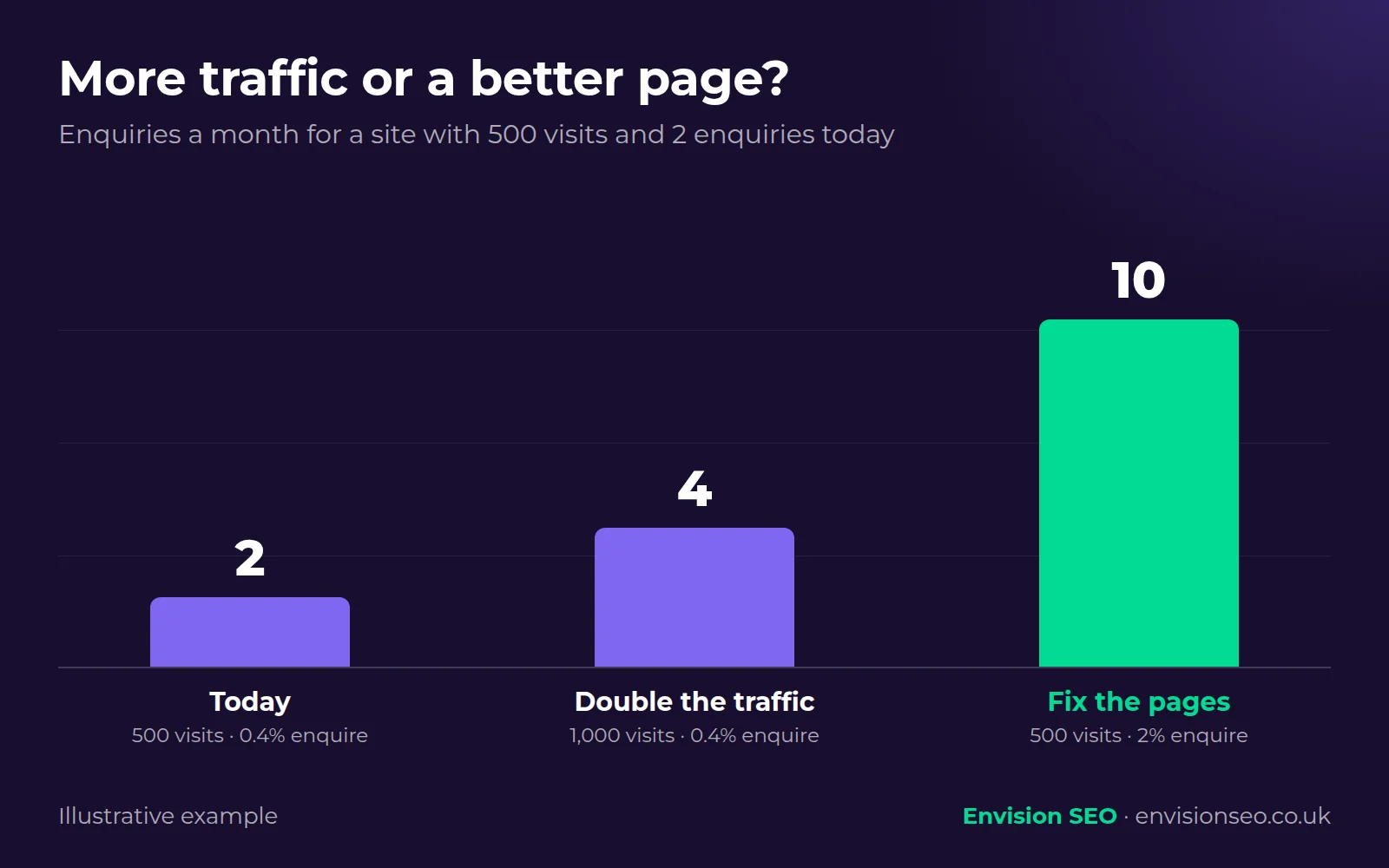
Real figures vary a lot by sector, and you won’t always be able to raise the enquiry rate that far. But it shows why more traffic isn’t automatically the answer.
I’ve seen how easily website traffic can become the centre of a marketing report. Rankings improve, impressions increase, traffic goes up. Everything looks positive.
Then someone asks the rather inconvenient question: How many new customers did we actually get?
Suddenly, the numbers don’t tell quite the same story.
This is why I prefer looking beyond rankings and traffic to understand what visitors are doing and whether they’re becoming genuine enquiries.
I explored this in more detail in my article about measuring SEO success beyond organic traffic, and for B2B firms in why a website with traffic still may not bring in clients.
There’s also the question of who is visiting.
For example, an accountancy firm might attract hundreds of visits to an article explaining how VAT works. That’s useful content and could help establish the firm’s expertise.
But somebody looking for a quick answer about VAT isn’t necessarily looking to hire an accountant.
A person searching for an accountant who specialises in limited companies, on the other hand, may be much closer to making a decision.
The second search might attract less traffic, but it could be considerably more valuable.
That doesn’t mean informational content has no place in your marketing strategy. It absolutely does. You just need to understand its role and make it easy for interested readers to explore your services.
People may be finding you, but are you giving them a reason to choose you?
Imagine you’re looking for a new accountant.
You open three websites.
The first tells you the firm provides professional accounting solutions tailored to your individual requirements.
The second says pretty much the same thing, just with slightly different wording.
The third explains that it specialises in helping small limited companies, outlines what its monthly service includes, introduces the accountants you’ll work with and shows genuine client feedback.
Which one would you be more inclined to contact?
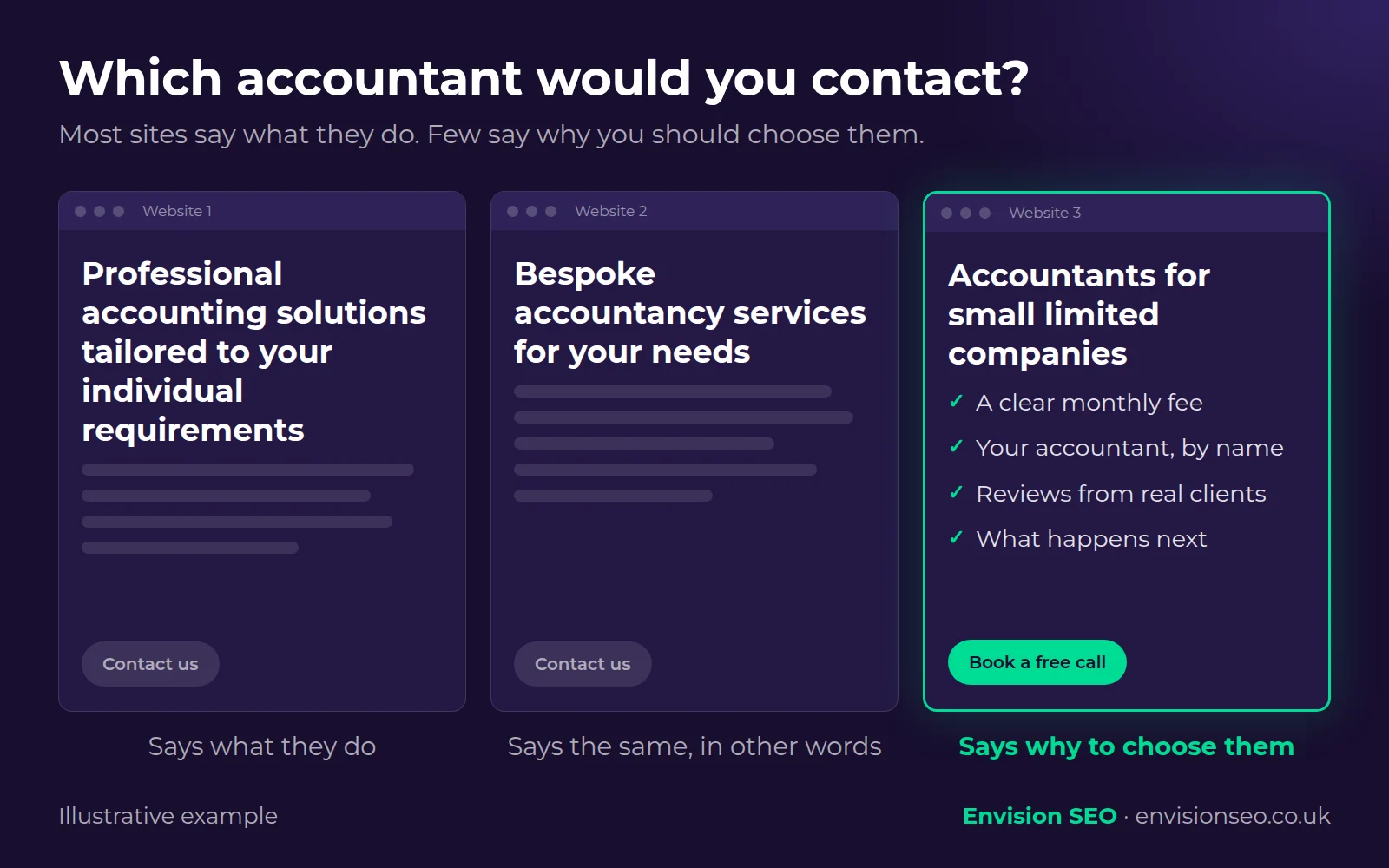
Most businesses are very good at explaining what they do. Far fewer explain why someone should choose them.
And that’s a missed opportunity.
Your website should answer the questions customers are already asking themselves.
- Can this business help with my particular problem?
- Have they worked with customers like me?
- What will the process involve?
- Can I trust them?
- And, importantly, what happens when I get in touch?
For some businesses, pricing information is important. For others, it’s examples of previous work, professional qualifications or reassurance about how the service works.
Consider a dental practice offering treatment to nervous patients. A page that simply lists the treatment may not be particularly reassuring. Explaining how the appointment works, what support is available and what the patient can expect could make a significant difference.
The same principle applies to B2B services, where decisions often involve higher costs and more than one person.
This is why I put so much emphasis on service-page content, customer reviews and real examples of work.
A well-written website shouldn’t make people work hard to understand whether you’re the right business for them.
Your competitors may be doing a better job of building trust
When somebody is considering an unfamiliar business, they’ll often look beyond its website.
They might read Google reviews, visit its social media profiles, check recent projects or compare it with other businesses offering similar services. Even your competitors’ bad reviews can tell you what those customers are looking for.
If one business has genuine customer feedback, relevant examples and clear information about its experience, while another has little more than a list of services, that difference can influence the decision.
It doesn’t mean the second business offers an inferior service. It means the potential customer has less information to judge it by.
This is particularly important for businesses where customers are making expensive or long-term decisions.
A kitchen company, for example, could benefit from showing completed installations, different design finishes and explaining what happens between the first consultation and installation.
A consultancy might benefit more from case studies that explain the client’s original problem, the work undertaken and the outcome.
I use this approach on Envision SEO’s own website. For example, my PromoVeritas SEO case study explains how I worked on the search visibility of a specialist promotional compliance business, rather than simply claiming that my SEO services deliver results.
Those examples allow potential clients to see the type of work I do and understand how it might relate to their own business.
You don’t necessarily need dozens of testimonials or an extensive portfolio. A handful of relevant, credible examples can be far more useful than pages of generic marketing claims.
Sometimes the problem is much simpler than SEO
Let’s imagine someone has found your website, read about your services and decided they want to contact you.
Great. That’s exactly what you wanted.
But now they have to find the contact page, complete a lengthy form and hope somebody gets back to them.
Or perhaps the phone number isn’t clickable on mobile.
Or the form displays a success message, but the email never reaches your inbox.
The last example is worth paying particular attention to.
Website forms can stop working because of plugin changes, email configuration problems or other technical issues. If enquiries aren’t being delivered, you could be losing opportunities without even realising it.
When reviewing websites, I don’t just look at keywords and rankings. I also want to understand what happens when somebody tries to become a customer.
Are the calls to action obvious? Does the contact form work? Can visitors navigate the website comfortably on their phones? Is there enough information to make an enquiry without having to hunt for answers?
These are all part of conversion rate optimisation, which is essentially about making better use of the visitors you already have.
And here’s something worth remembering: you can have the best Google rankings in your industry, but they won’t be particularly valuable if customers struggle to contact you.
Before spending money attracting more visitors, try submitting an enquiry through your own website.
Preferably on your phone.
A five-minute test you can do today:
- Open your website on your phone, starting from a page Google sends people to, not the home page.
- Find a way to get in touch. Count the taps it takes.
- Tap the phone number. Does your phone offer to call it?
- Fill in the contact form and send it.
- Check that the email arrives in the inbox you actually read, not in spam, and that the visitor gets a confirmation.
- Ask yourself how long a real enquiry would wait for a reply.
You might be surprised by what you discover.
What about Google AI Overviews and ChatGPT? Are they changing how customers find businesses?
Yes, and this is becoming increasingly relevant for businesses thinking about their long-term online visibility.
People aren’t always searching using a short phrase and clicking through a list of websites.
They may ask a more detailed question, compare several options through an AI assistant or read an AI-generated summary before deciding which businesses to investigate further.
For example, rather than searching only for “business accountant London”, someone might ask an AI assistant what type of accountant a growing limited company needs, what services should be included and what questions they should ask before hiring one.
That changes the type of information businesses need to make available.
It’s no longer enough to have a page repeating the same handful of keywords. Your website needs to explain your expertise, services, experience and the problems you help solve, clearly enough that Google and AI tools understand who you are and what you do.
But does that mean traditional SEO is no longer relevant?
Not at all.
Google’s guidance on optimising websites for AI search makes it clear that established SEO practices still matter. Google also emphasises the value of original content, first-hand experience and information that offers something genuinely useful.
In other words, there’s no magic AI shortcut.
A website that clearly explains its services, provides credible information and is technically accessible is building the foundations for both traditional and AI-assisted search.
The opportunity is to understand the questions your customers ask throughout their decision-making process, not just the keywords they type into Google. It’s also worth checking what AI assistants already say about your business.
You might be getting enquiries, just not the right ones
There’s another problem that doesn’t get discussed enough.
What happens when your website is generating enquiries, but very few turn into paying customers?
Perhaps people are contacting you about services you don’t offer. Or they’re outside your service area, have unrealistic budgets or misunderstand what your business actually provides.
For a consultancy, this could mean receiving enquiries from people looking for a quick, inexpensive service when the business specialises in complex, longer-term projects.
For a kitchen company, it might mean receiving quotation requests from people who haven’t understood the typical cost or scope of the work.
In these situations, generating more enquiries isn’t necessarily the answer.
You may need to be clearer about your services, explain who you work with or provide more information about what customers can expect.
There’s also the question of what happens after an enquiry arrives.
How quickly does someone respond? Is there a follow-up process? Do you know which enquiries became customers?
If you don’t know the answers, it’s difficult to judge whether your marketing is working.
This is one reason I pay close attention to website analytics and conversion tracking. Connecting search visibility to actual enquiries helps businesses make better decisions about where to invest.
It doesn’t have to involve an expensive CRM or complicated reporting system.
For a smaller business, even a simple record of where enquiries came from, whether they were relevant and whether they became customers is a useful starting point.
So, do you need better SEO, a new website or more advertising?
I wish there were one answer that worked for every business, but there isn’t.
If you’re not appearing for relevant searches, investing in SEO may make sense.
If people are already finding your website but leaving without contacting you, the priority might be improving the content, navigation or enquiry process.
If your business needs leads quickly, paid advertising could be worth considering, although the cost and suitability will depend on your industry.
And if your website is difficult to manage, has serious technical limitations or no longer supports what your business needs, a redesign might be justified.
| What you’re seeing | The likely priority | Check first |
|---|---|---|
| People only find you by searching your business name | SEO and local visibility | The searches in Search Console, your Google Business Profile |
| Plenty of visitors, very few enquiries | Service pages, trust and the enquiry process | Your best-visited pages, reviews, a test enquiry on your phone |
| Enquiries that don’t fit your services, area or budget | Clearer service information | Who your pages say you work with, and what they say it costs |
| You need enquiries this month, not next year | Paid advertising, alongside SEO | Cost per enquiry in your sector, and whether your pages convert |
| The site is hard to update or can’t do what you need | A rebuild may be justified | What exactly the current site stops you doing |
| You don’t know where enquiries come from | Tracking, before anything else | Analytics key events and a simple enquiry log |
But I wouldn’t recommend spending money on any of these until you’ve looked at what’s already happening.
Start by checking your website’s performance in Google Search Console and Google Analytics. They can help you understand which searches bring people to your website and how visitors interact with it.
Then look at the website from a potential customer’s perspective.
Can they quickly understand what you offer? Is there enough information to trust your business? Is it easy to get in touch? And are the enquiries you’re receiving actually relevant?
If you want to explore what additional organic traffic could mean for your business, I’ve also created a free SEO ROI calculator that lets you estimate potential enquiries and revenue using your own figures.
These checks won’t answer every question, but they’ll give you a much better starting point than simply deciding you need more traffic.
What would I prioritise if this were my business?
I’d resist the temptation to change everything at once.
- Make sure enquiries work and are recorded. There’s little point investing in visibility if you’re unable to measure whether customers are contacting you.
- Look at where existing visitors come from and whether they’re searching for services the business actually provides.
- Review the pages that should be generating enquiries. Not just their design, but whether they answer the right questions, demonstrate credibility and make the next step straightforward.
- Only then decide whether the biggest opportunity lies in improving search visibility, developing content or making changes to the website itself.
It’s not the most exciting answer, perhaps. But it’s usually a more sensible approach than throwing money at another marketing channel and hoping for the best.
Frequently asked questions
Why is my website getting visitors but no enquiries?
It could be attracting people who aren’t looking for your services, or potential customers may not be finding enough information to make a decision. Poor mobile usability, unclear calls to action and technical problems with contact forms can also contribute. Reviewing your traffic sources and testing the enquiry process is a sensible first step.
How can I get more enquiries from my website without paying for advertising?
Start with the visitors you already have. Improve your service descriptions, make contacting you straightforward, add genuine reviews or examples of your work and ensure related content links to relevant service pages. Small improvements won’t guarantee more enquiries, but they may help remove unnecessary barriers.
Why does my business appear on Google when I search its name but not its services?
Google may recognise your business name without considering your website sufficiently relevant or competitive for broader service searches. Reviewing your page content, keyword targeting, local visibility and Google Business Profile can help identify where improvements are needed.
Should I invest in SEO if my website isn’t getting customers?
Possibly, but first establish whether the problem is a lack of relevant visitors or a failure to turn existing visitors into enquiries. SEO can help attract suitable customers through search, but it won’t automatically resolve poor website usability, unclear service information or weaknesses in your sales process.
Do I need a new website to improve enquiries?
Not necessarily. Existing websites can often be improved through better content, clearer navigation, technical fixes and stronger calls to action. A rebuild is more appropriate when the current platform or structure prevents those improvements.
Final thoughts
If your website isn’t bringing in the customers you’d hoped for, don’t automatically assume you need more traffic or a bigger marketing budget.
The problem could be your search visibility, the quality of visitors you’re attracting, the information on your pages or something as simple as a contact form that isn’t working.
The important thing is to understand what’s happening before deciding what to spend money on.
That’s the approach I take at Envision SEO. I look at the bigger picture, from search visibility and content to website performance and the enquiries that matter to the business.
If you’re unsure where your website is falling short, you can book a free initial consultation to discuss what might be worth investigating.
Because ultimately, the goal isn’t just to bring more people to your website.
It’s to help the right people find your business and feel confident enough to get in touch.