


Every business wants more traffic to its website. And for years, increasing organic traffic has been one of the most recognisable signs of a successful SEO campaign.
Traffic goes up, the monthly report looks impressive, and everyone is happy.
But there’s a question that doesn’t always get enough attention: what are all those extra visitors actually doing?
Are they enquiring about your services? Buying your products? Becoming customers? Or are they simply arriving, finding an answer and leaving?
Because those are very different outcomes.
A website attracting 3,000 relevant visitors who are genuinely interested in what a business offers can be far more valuable than one attracting 30,000 people who were never likely to become customers.
This doesn’t mean traffic is irrelevant. It means that more traffic and better SEO aren’t necessarily the same thing.
And as search behaviour continues to evolve, that distinction is becoming increasingly important.
Key takeaways
- More organic traffic isn’t the same as better SEO. What matters is whether visitors become enquiries, customers and revenue.
- The intent behind a search usually matters more than its volume. A small audience looking for exactly what you offer often brings more business than a large one with a passing interest.
- AI Overviews and AI search answer many questions on the results page, so traffic on its own is an even weaker signal than it used to be.
- Measure SEO success with qualified enquiries, organic conversion rate, revenue, the performance of commercial pages and return on investment.
We’ve Become a Little Too Obsessed With Traffic
Organic traffic is easy to understand. It’s measurable, straightforward to visualise and relatively simple to compare month after month.
It’s also a convenient way to demonstrate progress.
A 40% increase in organic sessions looks impressive in a presentation. It’s a tangible result that everyone can recognise, even without much SEO knowledge.
The problem begins when that number becomes the main definition of success.
Imagine a business investing in SEO to attract more commercial enquiries. After six months, its organic traffic has doubled.
Great news, surely?
Not necessarily.
If most of that growth comes from informational blog posts attracting people outside the business’s target market, the increase might have little commercial value.
The traffic is real. The SEO work may have genuinely improved visibility. But the business objective hasn’t necessarily been achieved.
And that’s the distinction worth making.
SEO can improve search visibility without delivering the business growth someone expected from it.
That doesn’t automatically make the campaign unsuccessful. Informational content can play an important role in brand awareness, customer education and future demand.
But those benefits need to be understood and measured appropriately, rather than assumed from an upward-trending graph.
Not All Organic Traffic Has the Same Value
Consider two hypothetical websites offering specialist B2B services.
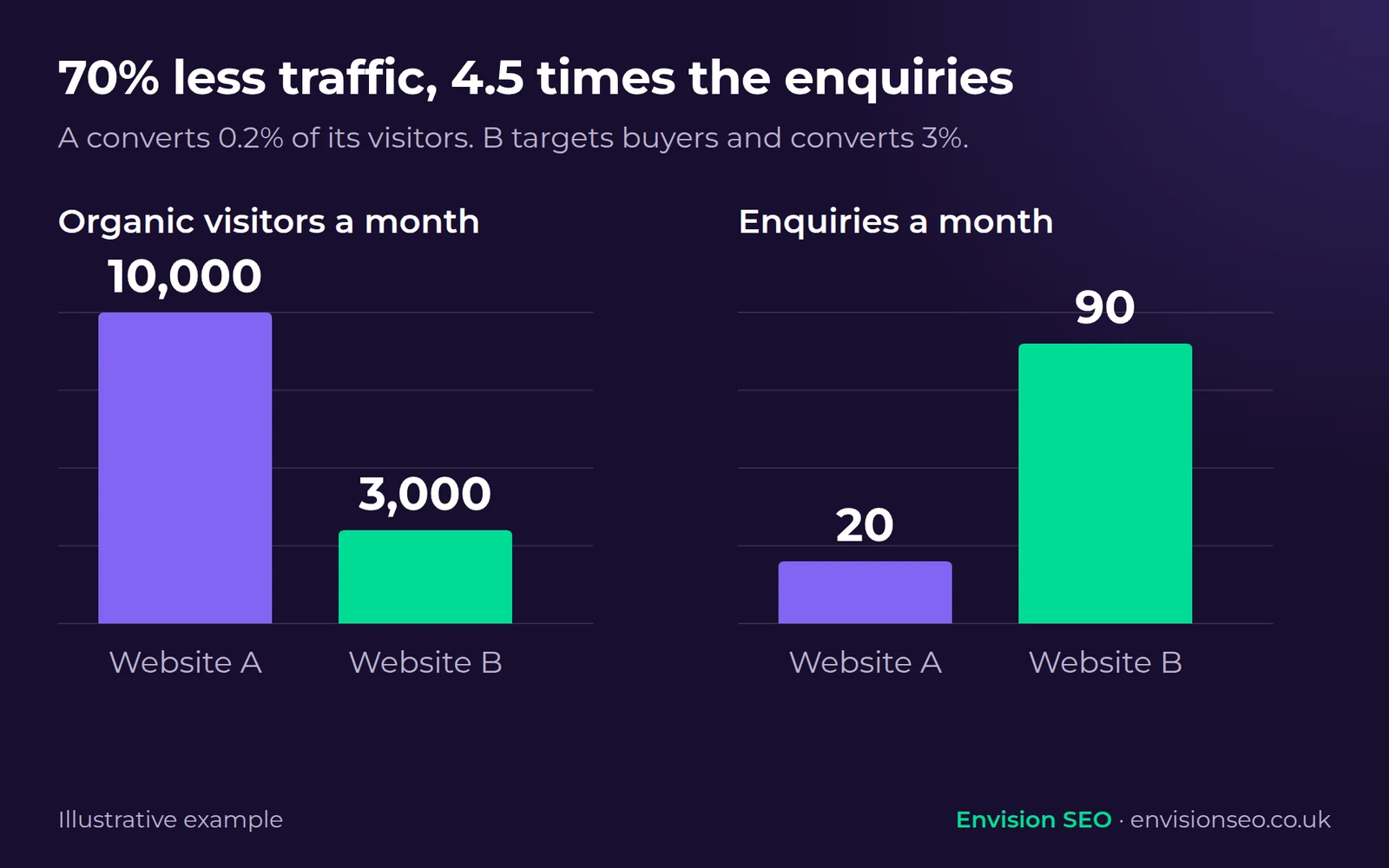
Website A attracts 10,000 organic visitors per month. Its content performs particularly well for broad informational searches, but only 0.2% of visitors submit an enquiry.
That’s 20 enquiries.
Website B attracts 3,000 organic visitors per month. It receives significantly less traffic, but its pages target more specific commercial searches, and 3% of visitors submit an enquiry.
That’s 90 enquiries.
Website B receives 70% less organic traffic but generates 4.5 times as many enquiries.
Of course, enquiries aren’t the final measure of success either. We still need to understand how many are qualified, how many become paying customers and what those customers are worth.
But the example illustrates something important.
The relevance of your visitors can matter considerably more than their number.
For a service-based business, attracting someone searching for a solution they are ready to purchase may be far more valuable than attracting hundreds of people researching a loosely related topic.
This is where search intent becomes essential.
Search Intent Matters More Than Most Businesses Realise
Two people can search for similar topics while being at completely different stages of their buying journey.
Someone searching for “what is technical SEO?” is probably looking for information.
Someone searching for “technical SEO consultant UK” may be actively considering hiring a specialist.
Both searches are relevant to an SEO consultancy. Both can have a place in a content strategy.
But they serve different purposes.
The first might help introduce a potential customer to your expertise. The second is more closely connected to a commercial decision.
Neither is inherently better. The question is whether your content strategy supports the outcomes you’re trying to achieve.
For an established business looking to generate enquiries, that usually means understanding which searches bring visitors with genuine commercial potential.
It also means recognising that a keyword with a lower search volume can sometimes be far more valuable than a broader, more competitive term.
A smaller audience looking for exactly what you offer is often a better starting point than a large audience with only a passing interest.
And no, this doesn’t mean every website should abandon informational content and target only transactional keywords.
It means informational content should have a purpose within the wider customer journey.
AI Search Is Making Traffic Numbers Even Harder to Interpret
There’s another reason businesses need to reconsider how they evaluate organic traffic.
People no longer discover information through traditional search results alone.
Google’s AI Overviews, ChatGPT, Perplexity and other AI-powered search experiences are changing how users research products, compare services and find answers.
Sometimes, users can get what they need without visiting a website at all.
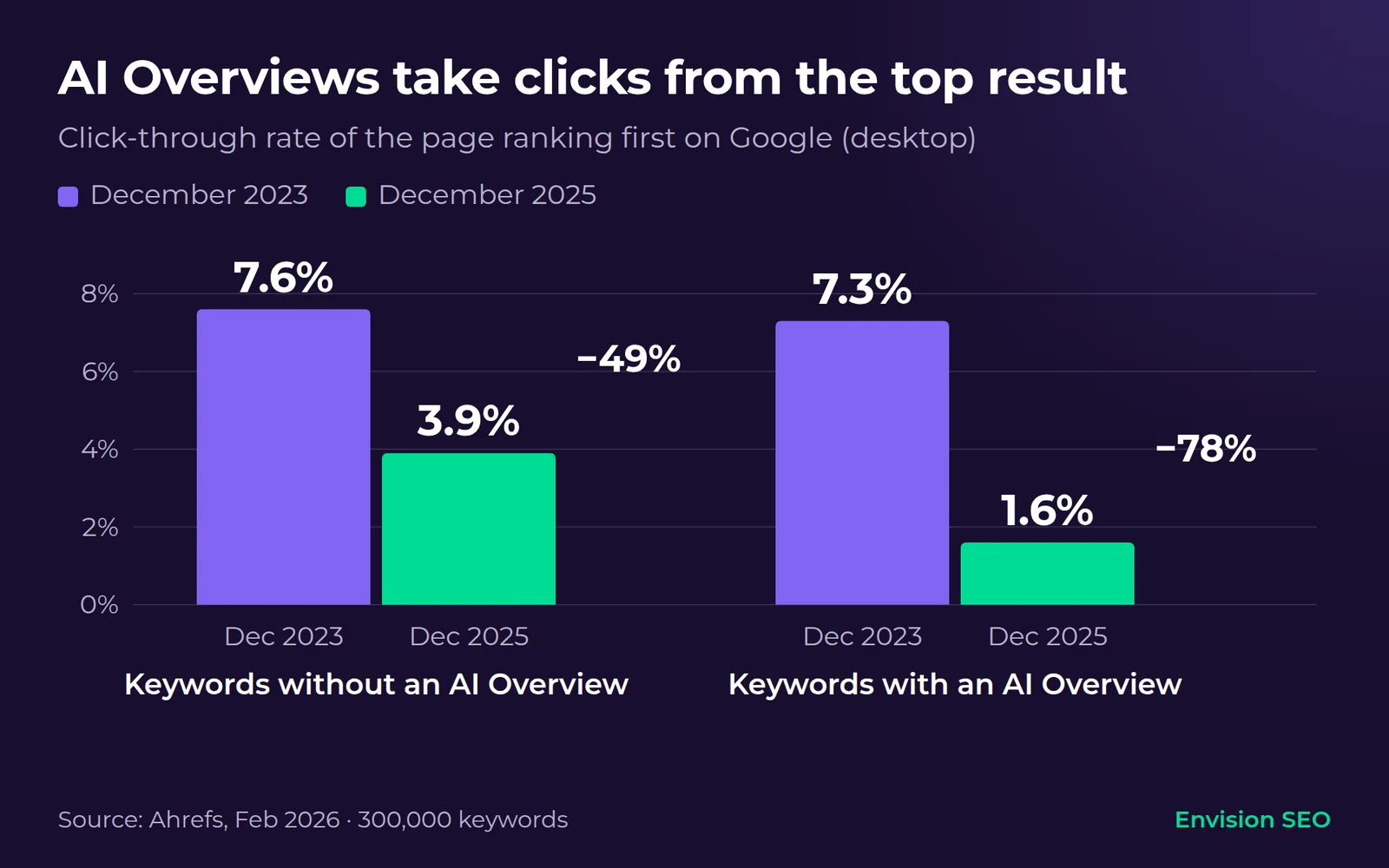
The effect shows up in the data. Ahrefs analysed Google Search Console data for 300,000 keywords and found that when an AI Overview appears, the page ranking first now gets around 58% fewer clicks than expected (Ahrefs, February 2026).
This creates an interesting problem for SEO measurement.
A business might appear in an AI-generated answer, be referenced as a useful source or become part of someone’s research journey without receiving a measurable website visit.
At the same time, another business might lose organic clicks because users are finding answers directly in search results.
Neither situation can be understood by looking at traffic numbers alone.
However, there’s an important distinction here.
Fewer clicks don’t automatically mean better-quality visitors.
It’s tempting to assume that people who do click through from AI-powered search experiences are more qualified, but that won’t be true in every situation. It depends on the query, industry, user behaviour and type of answer being provided.
Similarly, declining organic traffic shouldn’t automatically be dismissed as a harmless consequence of AI search.
Sometimes traffic is falling because rankings have declined, competitors have improved, demand has changed or technical problems are preventing pages from performing.
The challenge is understanding why the numbers are changing.
For businesses, this means looking at traditional organic performance alongside search visibility, relevant brand mentions, referral traffic and actual customer behaviour.
AI visibility is another useful piece of the picture. It isn’t a replacement for measuring real business outcomes.
The Metrics That Actually Tell You Whether SEO Is Working
If traffic alone doesn’t give us the full picture, what should businesses measure instead?
The answer depends on the business model, but several metrics provide a much better indication of SEO’s commercial contribution.
1. Qualified enquiries, not just form submissions
An increase in enquiries sounds positive until you discover that most are irrelevant, outside your service area or looking for something you don’t offer.
For lead-generation websites, understanding the quality of enquiries is just as important as counting them.
Where possible, businesses should connect website leads with CRM data to understand which channels and landing pages attract genuine potential customers.
2. Organic conversion rate
Conversion rate helps establish what proportion of organic visitors complete a meaningful action.
That might be submitting an enquiry, requesting a quote, booking a consultation or completing a purchase.
However, conversion rate also needs context.
A high conversion rate based on a very small audience isn’t automatically better than a lower rate generating substantially more profitable customers.
Look at conversion volume, quality and value together.
3. Revenue generated from organic search
For ecommerce businesses, revenue and profitability provide a clearer picture than sessions alone.
For service businesses, this can be more complicated because a visitor might make an enquiry today and become a customer several weeks later.
Connecting leads to actual sales helps businesses understand whether their SEO investment contributes to revenue.
Attribution will never be perfect, particularly when customers interact with several channels before buying. But even an imperfect, clearly explained view of commercial outcomes is more useful than pretending every organic visitor has equal value.
4. Performance of commercially important pages
Not all landing pages contribute equally to business objectives.
A blog article might receive thousands of visits while a specialist service page receives only a few hundred.
If the service page generates qualified enquiries, its commercial contribution could be substantially greater.
This is why SEO reporting should distinguish between different types of content rather than treating the entire website as one traffic figure.
5. Customer acquisition cost and return on investment
Ultimately, a business needs to understand what it receives in return for its investment.
That includes the cost of SEO activity, the number and value of customers acquired, and the profitability of those relationships.
Return on investment should be evaluated over a realistic timeframe, particularly because SEO often requires upfront work before benefits materialise.
The objective isn’t to attach a perfect financial value to every click.
It’s to make better decisions about where marketing resources are being spent.
Sometimes the Problem Isn’t Traffic. It’s What Happens Afterwards.
There’s another part of this discussion that deserves more attention.
Businesses often assume that disappointing SEO results mean they need better rankings or additional traffic.
But what happens if the website is already attracting relevant visitors?
What if the real problem sits somewhere between arriving on the website and becoming a customer?
A contact form might not be working correctly. Conversion tracking might be missing important actions. A mobile page might be difficult to navigate. Or a service page might fail to explain clearly why someone should choose the business.
These problems can easily be overlooked when attention is concentrated on search rankings and traffic growth.
And they can have a direct impact on the value generated from existing visitors.
Before investing in attracting another thousand people to a website, it can be worth asking whether the website is making the most of the visitors it already receives.
This is also why SEO shouldn’t operate entirely separately from website usability, conversion optimisation and analytics.
Driving relevant people to a website is only one part of the process.
Helping them take the next step matters too.
Does This Mean Businesses Should Stop Trying to Increase Organic Traffic?
Absolutely not.
Organic traffic growth can be incredibly valuable.
It can help businesses reach new audiences, establish expertise, introduce people to unfamiliar services and build demand long before someone is ready to buy.
For publishers, advertising-funded websites and businesses with broader brand-awareness objectives, audience volume may also have considerable value in its own right.
And even for lead-generation businesses, today’s informational visitor could become tomorrow’s customer.
The mistake isn’t wanting more traffic.
The mistake is treating all traffic growth as equally valuable, regardless of where it comes from or what it contributes.
A strong SEO strategy should make room for different stages of the customer journey while remaining clear about what success looks like for each one.
Some content exists to educate. Some builds trust. Some addresses commercial questions. And some is designed to support an immediate conversion.
Those pages shouldn’t all be judged using exactly the same criteria.
| The page’s job | Examples | Judge it by |
|---|---|---|
| Educate | Guides such as “What is technical SEO?” | Visibility for the topic, returning visitors, enquiries it helped start later |
| Build trust | Case studies, about page, reviews | Visits from people already considering you, contact page visits after reading |
| Answer commercial questions | Pricing, comparisons, “how to choose” guides | Clicks through to service pages, enquiries |
| Convert | Service and contact pages | Qualified enquiries and the customers they become |
How to Tell Whether Your Organic Traffic Is Actually Valuable
You don’t need an unnecessarily complicated reporting system to start asking better questions.
Begin by reviewing your organic traffic alongside the outcomes that matter to your business.
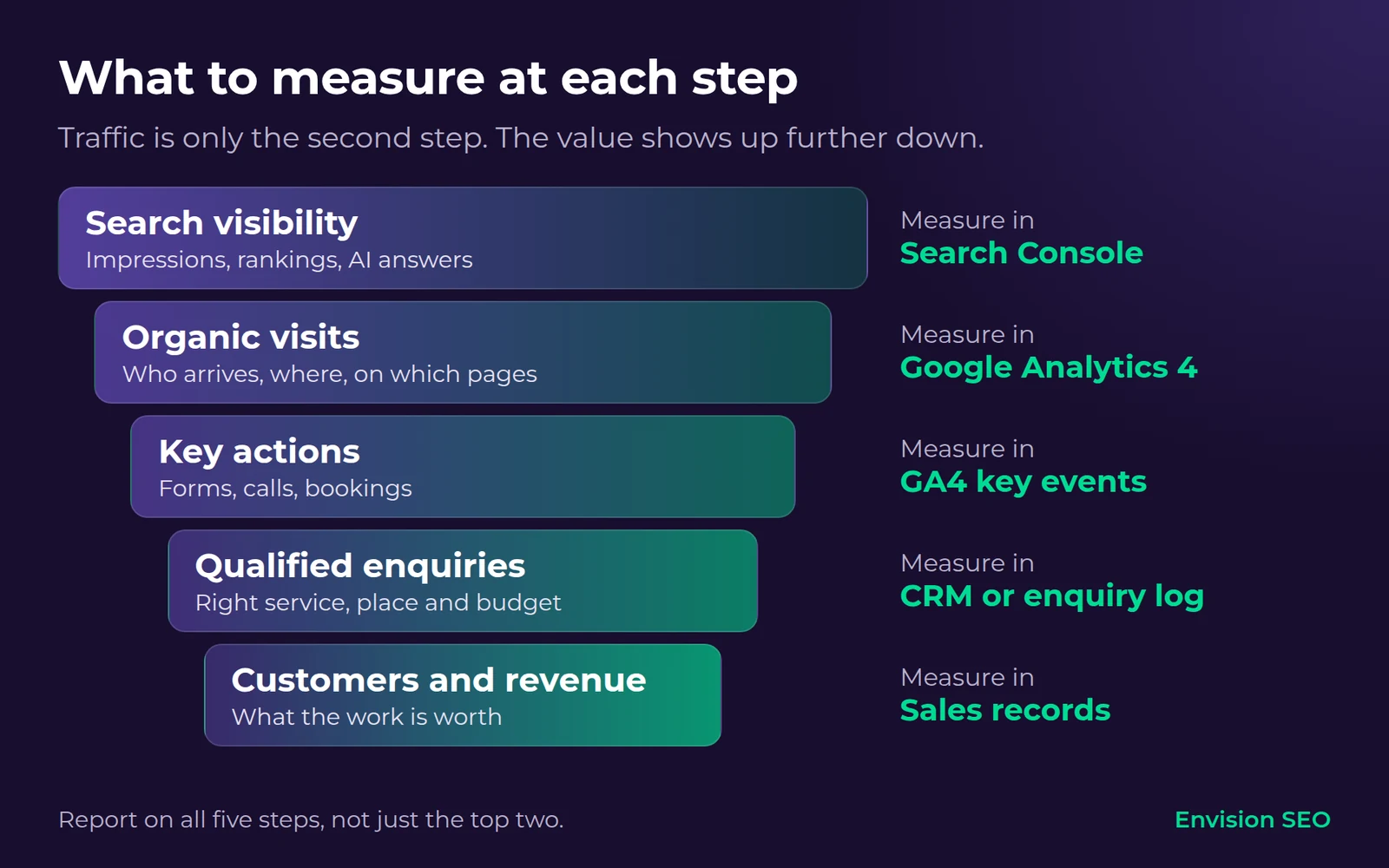
Google Search Console can help identify which queries and pages generate search visibility and clicks.
Google Analytics 4 can show how organic visitors interact with your website and which key events they complete, provided tracking has been configured correctly.
Your enquiry records, sales data or CRM can then help establish whether those interactions result in real business opportunities.
The most useful questions include:
- Which organic landing pages generate relevant enquiries or sales?
- Are we attracting visitors from the locations and audiences we actually serve?
- Which search queries indicate commercial interest?
- Are our most important services becoming more visible?
- Do we know what happens to leads after they contact us?
- Is traffic growth contributing to revenue, brand awareness or another defined objective?
You should also consider whether your measurement setup is reliable.
There is little value in making strategic decisions from conversion data if important forms, phone calls or other customer interactions aren’t being tracked accurately.
For businesses already investing in SEO, these checks can reveal opportunities that wouldn’t be obvious from traffic reports alone.
Better SEO Should Mean Better Business Outcomes
I don’t think organic traffic is a vanity metric by default.
It’s an important indicator of how people discover and interact with a website through search.
But it becomes misleading when it’s presented without context or treated as the ultimate measure of SEO success.
A business with declining traffic and increasing qualified enquiries deserves a closer look before anyone declares its SEO strategy a failure.
Equally, a business celebrating record-breaking organic traffic should be able to explain what that growth means commercially.
Sometimes, the right strategy really is to attract more visitors.
Other times, it’s to target a smaller, more relevant audience, improve existing landing pages, fix conversion problems or rethink which search queries deserve attention.
The goal shouldn’t be to make every graph go up.
It should be to make SEO contribute something meaningful to the business.
And sometimes, that means fewer visitors, better opportunities and stronger results.
Frequently Asked Questions
Is organic traffic a vanity metric?
Not by default. Organic traffic shows how people find your website through search, but on its own it doesn’t show whether those visitors are the right people. It becomes a vanity metric when it’s reported without enquiries, sales or another business outcome next to it.
How do you measure SEO success?
Start with the outcome the business wants, usually qualified enquiries or sales, and work back from it: which organic landing pages and search queries lead to those outcomes, how many of the enquiries are qualified, and what they are worth. Traffic, rankings and AI visibility then help explain why those numbers are moving.
What is a good organic conversion rate for a service business?
It varies with the sector, the offer and what counts as a conversion, so published benchmarks are only a rough guide. Industry surveys often put enquiries from organic search for B2B services at around 2 to 5% of visitors. Your own trend over time, and the quality of the enquiries, matter more than any benchmark.
Why is my organic traffic falling when my rankings haven’t changed?
Often because more searches are answered on the results page itself, for example in AI Overviews, so fewer people click through even when your position holds. Compare clicks, impressions and click-through rate in Search Console before assuming something is broken, and check whether your enquiries have changed too.
Should I stop publishing informational blog content?
No. Informational content introduces people to your expertise and can lead to enquiries later. Give each piece a clear job in the customer journey and judge it by that job, not by traffic alone.
Is Your Organic Traffic Delivering Business Value?
I look beyond rankings and traffic numbers to understand how search visibility contributes to your wider business objectives.
From technical SEO and search intent analysis to conversion tracking and AI search visibility, the focus is on identifying what is working, what isn’t and where improvements can make a commercial difference.
Want to understand what your organic traffic is really worth?
Try my SEO ROI calculator or get in touch to discuss your website’s performance.